Framework


Organizations routinely complete work without preserving the state that made it intelligible: why it was authorized, which conditions governed it, what changed, what evidence supported the result, and why it was accepted. The output survives, but its context decays. Each new cycle must reconstruct the same conditions, creating activity without increasing the organization’s capacity to complete future work.
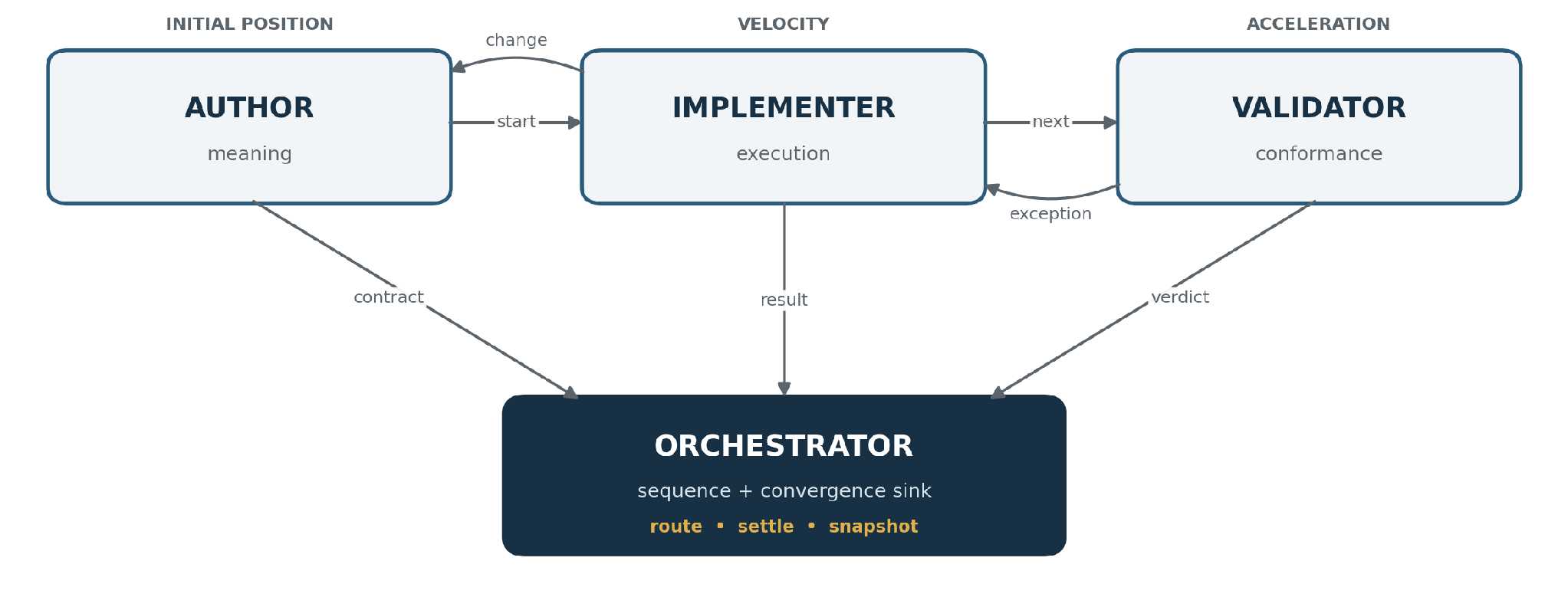
Domain makes completed work a reusable organizational state. Organizational acceleration is the increasing capacity to move from authored intent to implemented change to verified outcome because each completed cycle improves the starting conditions of the next. Stable responsibility boundaries preserve meaning, execution, conformance, and sequence even as the people, agents, and applications performing those roles change.
x(t) = x₀ + v₀t + ½at²
The kinematic model makes the second-order structure visible: x₀ is the authored initial position; v₀t is implementation producing movement; and ½at² is verification changing the trajectory of later implementation. Here, t is process progression, not literal elapsed time. At convergence, the Orchestrator emits a recoverable snapshot that becomes the next cycle’s initial position. Velocity describes one cycle; organizational acceleration describes whether the relationship between cycles is improving.